What the New UN ADS Regulation Means for the Industry:
By Dr Elliot London, Simulation Performance Engineer, rFpro
Earlier this year, the UNECE Working Party on Automated/Autonomous and Connected Vehicles (GRVA) adopted a draft Global Technical Regulation (GTR) for Automated Driving Systems (ADS). This framework will establish the first globally harmonised regulatory basis for deploying autonomous vehicles on public roads. For those of us working in simulation, the implications are significant: this regulation moves simulation from a ‘nice to have’ to a legal requirement.
What the regulation requires
The draft GTR establishes that manufacturers must demonstrate the safety of their ADS through a combination of simulation, test bench procedures and real-world driving. Simulation is not offered as an optional shortcut, it is embedded as an essential pillar of the safety case that manufacturers must submit before an ADS can be approved.
A central element is documentation. Manufacturers must describe their simulation toolchains and identify their scope of applicability, limitations, assumptions and sources of uncertainty. Numerical error estimates must be documented. Validation test outcomes must be reviewed, and any discrepancies between simulated and real-world results must be explained. The regulation demands a fully traceable chain of evidence from simulation to safety claim.
The regulation is deliberately framework-oriented, it states what must be demonstrated but does not prescribe how. There is no mandated level of simulation fidelity; instead, quality must be proportionate to the risk involved. There are legitimate reasons to use lower-fidelity simulation for certain tasks, but for high-stakes safety decisions, the implication is clear: you want the most accurate and physically grounded simulation you can achieve.
Why this matters
This framework changes the role of simulation in the development process. Previously, the extent and quality of simulation was at each manufacturer’s discretion. Now, simulation quality becomes part of the regulatory record. If an incident occurs, the framework enables the relevant authority to review the entire development chain and assess whether due diligence was properly conducted. The documentation trail should reveal where and how any error occurred.
The responsibility for this documentation is distributed across the supply chain. For a simulation provider like rFpro, this means providing evidence that our simulation environment and models are grounded in proper physics. This spans three domains: the environment (the physics of weather, lighting and atmospheric conditions), the scene (objects such as vehicles and pedestrians, their material definitions and how they interact with light), and the sensor (how a simulated perception system perceives what is being rendered). Each of these must be validated and the validation must be documented.
At rFpro, we have undertaken an exhaustive process to validate and document the performance of our simulation platform:
- The physical interactions of our lighting system, fog and overcast clouds have been fully validated against theoretical data.
- We have developed a new generic camera sensor model where the full-stack CMOS and ISP camera sensor implementation has been validated against both theoretical and experimental reference data during our involvement in the Sim4CamSens projects[RD1.1].
- Material definitions are calibrated to ensure light interacts with objects as it would in the real world.
- For each element, we document the tests conducted, the parameter ranges over which validity holds, user recommendations and, critically, any known limitations. All simulation engines have limitations. The important thing is to understand them, be transparent about them, and define the ranges within which results can be trusted.
The industry response
Quantifying simulation quality is inherently difficult. How accurate a simulation is depends entirely on how it is configured and rendered, making direct comparisons between toolchains extremely challenging. This is likely why the regulation avoids specifying a particular accuracy threshold.
Addressing this gap is exactly the work being done through initiatives like the ASAM Quantifying Simulation Quality (QSQ) group, of which rFpro is a member. This European-led effort is working to establish standardised metrics for assessing simulation quality, which is a problem that has lacked a common vocabulary. In the UK, the collaborative Sim4CamSens project has a similar ambition, and part of its work involved dissecting the draft regulation to understand its implications and direct the work packages being delivered. Sim4CamSens2 has extended the scope to include in-cabin sensor simulation, reflecting the growing importance of driver and passenger monitoring systems as a core element of ADS safety.
Looking ahead
The draft GTR is expected to go to a vote in June 2026. If adopted, contracting parties can incorporate it into domestic legislation. For simulation providers and the engineers who rely on them, the direction of travel is clear. Simulation is now mandatory, and so is validating and documenting it. It is now a core part of how we demonstrate that autonomous vehicles are safe to share the road with the rest of us.

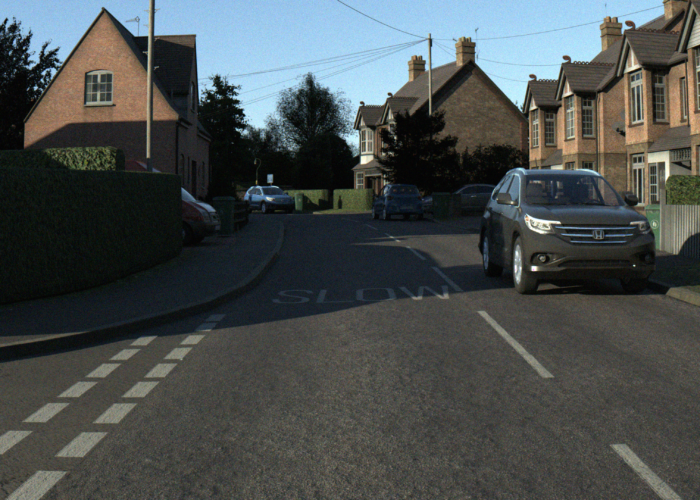
Image of field test – simulation

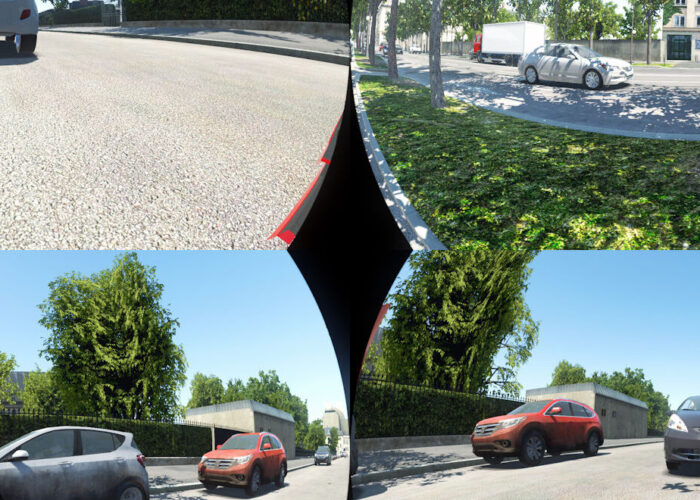
Image of field test – camera
___________________________________________________________________________________________________________________
About rFpro
rFpro, a member of the AB Dynamics Group plc, provides a simulation environment for the automotive and motorsport industries. It is used for the development and testing of autonomous vehicles, ADAS, vehicle dynamics and human factor studies. rFpro’s automotive customers are the world’s largest car manufacturers, tier one suppliers and sensor developers. We enable them to simulate, test and validate new sensors, control systems and vehicle hardware systems. The top ten OEMs that were early adopters of rFpro technology have already launched road cars which started their development, not on a test track, but in a rFpro’s virtual environment.
In motorsport we are the market leader of professional driver-in-the-loop simulator software – our customers include past and present champions of every leading motorsport category. We maintain the largest library of digital circuit models (digital twins) including race circuits for F1, NASCAR, WEC, IMSA, Indy, Formula E, Super-GT and Australian V8 Supercars. rFpro’s vision is for every driving simulator experiment to be conducted using the rFpro engineering-focused simulation engine. On every driving simulator, local or cloud-based, rFpro will form a fundamental part of vehicle development.
Press Contact
Richard Doherty at Automotive Technology PR
+44 (0)7814 961855
Richard.doherty@autotechpr.com